
SHOPIFY TECHNICAL SEO CASE STUDY
Shopify Technical SEO Case Study: +232% Organic Clicks
Technical SEO Review and Organic Search Performance in a Shopify Store
A Shopify store with products, collections, and existing organic visibility needed a clearer view of its crawlability, indexation, internal links, and page-level SEO signals.
3.04K → 10.1K clicks
Google Search Console · last six months versus previous six months
Starting Point and Main Problem
The store already had products, collections, and some organic search activity. Important pages were not getting the full value they could, and technical SEO needed attention alongside content.
The review sought clearer signals about which pages mattered, which URLs should be indexed, how product and collection pages connected, where internal links were weak, and which issues deserved attention first.
Themes, apps, product URLs, collection pages, internal links, and template settings can all affect Shopify visibility. The project focused on examining the store’s actual signals rather than applying a generic checklist.
Original Google Search Console Evidence
Google Search Console recorded 10.1K organic clicks in the last six months, compared with 3.04K in the previous six months. That is approximately +232%.
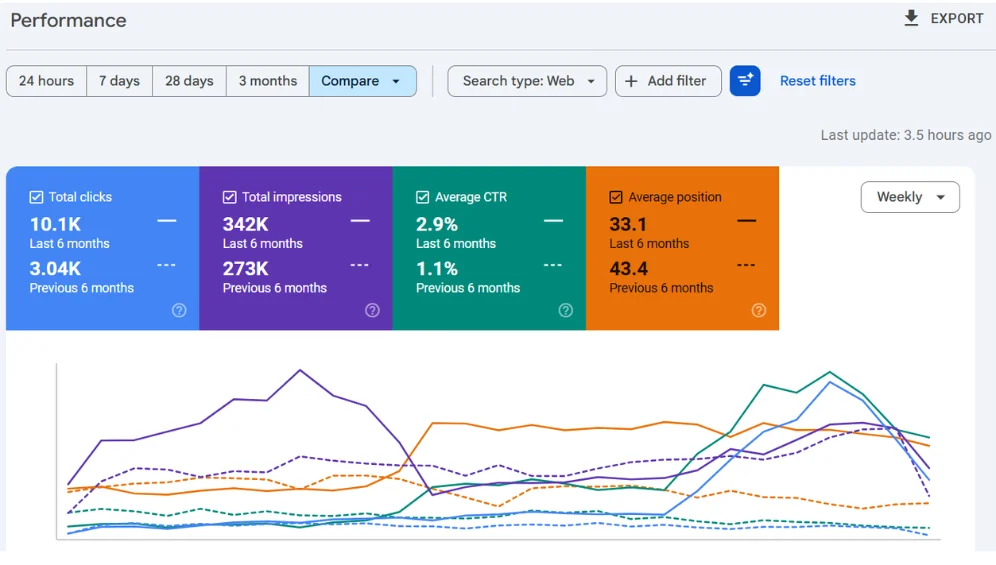
Google Search Console clicks comparison: last six months versus previous six months. Client details hidden for privacy.
View full-size Google Search Console evidence →
This comparison documents the change in clicks; by itself, it does not establish which work caused the change.
Technical Investigation
The review used Google Search Console and technical SEO checks to distinguish priority issues from lower-value warnings. It examined indexed and non-indexed pages, collection and product visibility, crawl paths, and pages with growth potential.
Crawlability and indexation
The review considered whether Google could find and understand the right collection, product, blog, and key landing pages. It checked sitemap signals, internal link paths, weakly linked or deep pages, and duplicate or unclear URL patterns.
Collection-page signals
Collection pages were reviewed for titles, headings, internal links, page-content signals, product-to-collection relationships, template patterns, crawl paths, and indexation signals. The aim was clearer technical and structural support for important commercial pages, not a rewrite of every page.
Product pages and URL signals
Product and collection paths were checked for product-page indexation, canonical behavior, duplicate URL patterns, internal links to important products, product-to-collection relationships, titles and headings, and structured signals where relevant.
Site architecture and technical consistency
The audit also considered metadata patterns, page structure, technical signals across templates, and the connections between priority pages. These were review areas; the available account does not identify a specific broken URL or prove that every item required a fix.
Documented Work and Prioritization
The case account describes a technical SEO review followed by priority-led cleanup. It focused on issues likely to matter for organic visibility rather than treating every tool warning as urgent.
Areas described as reviewed and improved include:
- Indexation signals and crawl paths
- Internal links and collection-page structure
- Product-page and page-level SEO signals
- Metadata patterns and technical consistency
- Google Search Console issues and template-level patterns
The source describes these areas at a high level. It does not identify each deployed change, an implementation date, or a developer assignment, so the case study does not present those details as verified facts.
Observed Result and What It Means
Google Search Console shows organic clicks increasing from about 3.04K to 10.1K in the last six months versus the previous six months—approximately +232%.
This is an observed comparison, not a forecast or a guarantee for another Shopify store. The screenshot does not isolate the effect of individual technical changes or prove that technical SEO alone caused the increase.
The practical value of the work was a clearer technical diagnosis, prioritized next steps, and attention to important ecommerce pages and their search signals.
Practical Lessons for Shopify Stores
1. Start with Google Search Console data
Search Console shows which pages receive clicks and impressions and where important pages may be missing or underperforming. Use observed data to guide the review.
2. Give collection pages clear signals
Collection pages can be valuable organic landing pages. Their structure, internal links, headings, and indexation signals deserve attention when visibility is weak.
3. Prioritize technical issues
Not every warning has the same impact. Separate issues that could affect important pages from low-value cleanup.
4. Strengthen internal links
Internal links help search engines discover and understand the relationship between product and collection pages.
5. Follow through after the audit
A report is useful when important fixes are implemented and reviewed. Technical SEO work needs follow-through.
Unlike a general ecommerce case study centered on content, backlinks, or keyword growth, this account focuses on crawlability, indexation, page structure, collection and product signals, internal links, templates, and GSC observations. A generic checklist may miss platform-specific patterns.
Frequently Asked Questions
Get a Shopify Technical SEO Review
If your Shopify store has indexing issues, weak collection visibility, traffic drops, or unclear technical SEO problems, I can review the visible signals first.
Send your store URL and a short note about the issue.
If there is a clear technical SEO problem, I will explain the next step.
If the issue does not look technical, I will tell you that too.