
TECHNICAL SEO RESULTS
Technical SEO Case Studies for Shopify & WooCommerce Stores
Four detailed case studies and one on-page mini case show observed changes in organic search and indexing.
Explore the original Google Search Console comparisons. The separate WooCommerce Semrush estimate is identified as an estimate, not a GSC measurement.
FIVE DOCUMENTED COMPARISONS
Results at a Glance
Choose a result to see its context, source, original evidence, and next step.
ORIGINAL SEARCH EVIDENCE
Explore the Case Studies
Each account pairs documented work with an observed comparison and its original evidence image.
CASE STUDY 01 · SHOPIFY
+232% organic clicks — Google Search Console
A Shopify subscription store had strong product quality, but organic visibility did not reflect it.
The documented work focused on crawl efficiency, indexing signals, internal links, template-level issues, and page-level SEO opportunities. The review considered several smaller technical signals rather than one obvious error.
Observed GSC clicks: 3.04K → 10.1K, last six months versus previous six months.
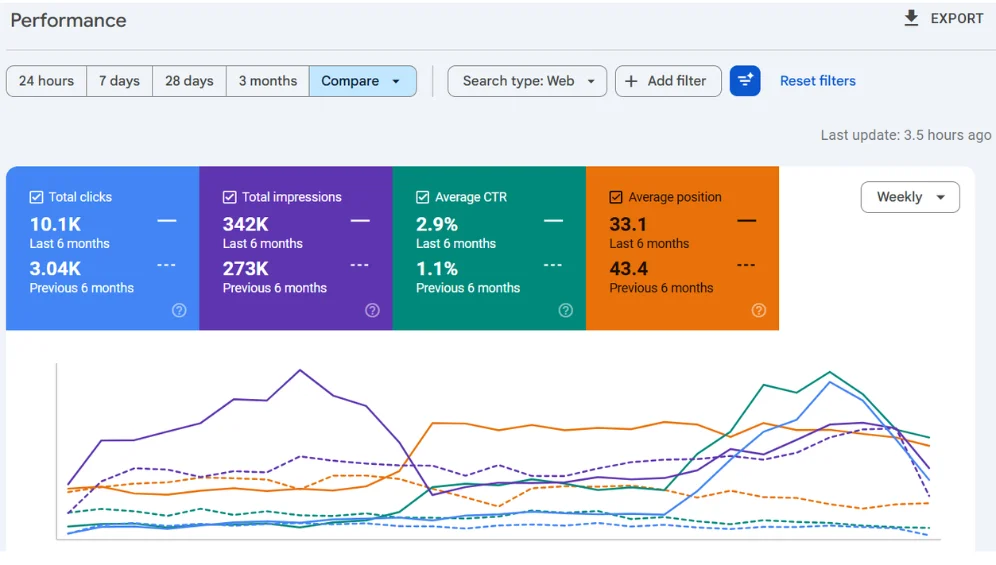
Google Search Console clicks comparison, last six months versus previous six months. Client details hidden for privacy.
CASE STUDY 02 · WOOCOMMERCE
12.5K → 15.1K GSC organic clicks
A WooCommerce store needed ongoing SEO support beyond a one-time audit. Its documented work included GA4/GTM tracking setup, technical SEO review, internal linking, performance checks, priority-page improvements, and keyword and competitor research.
Observed Google Search Console comparison: organic clicks 12.5K → 15.1K; impressions 2.08M → 2.65M.
Better tracking and a clearer technical SEO foundation helped the team make decisions from data rather than guesses.
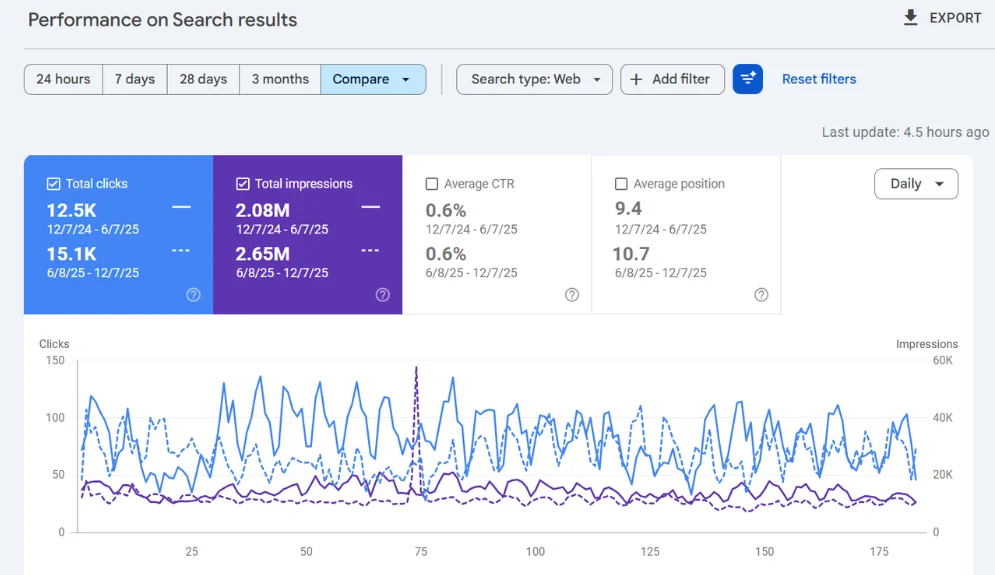
Google Search Console comparison of organic clicks and impressions. Client details hidden for privacy.
Separate Semrush estimate — estimated monthly organic visits, not GSC clicks. Semrush estimated approximately 2.3K → 9.8K monthly organic visits, about 4.3x, over its comparison period.
CASE STUDY 03 · ECOMMERCE PAGE
+126% page-filtered organic clicks
An existing ecommerce page was receiving impressions but relatively few clicks. The documented work refined its content structure, title and H1, internal linking, and sections addressing related search questions.
The page-filtered GSC comparison shows clicks 187 → 423 and average position 14.3 → 7.5, previous three months versus last three months.
Adding more content alone was not the answer; the page needed clearer intent alignment and stronger internal support. This is a page-level observation, not a storewide traffic claim or proof of causation.
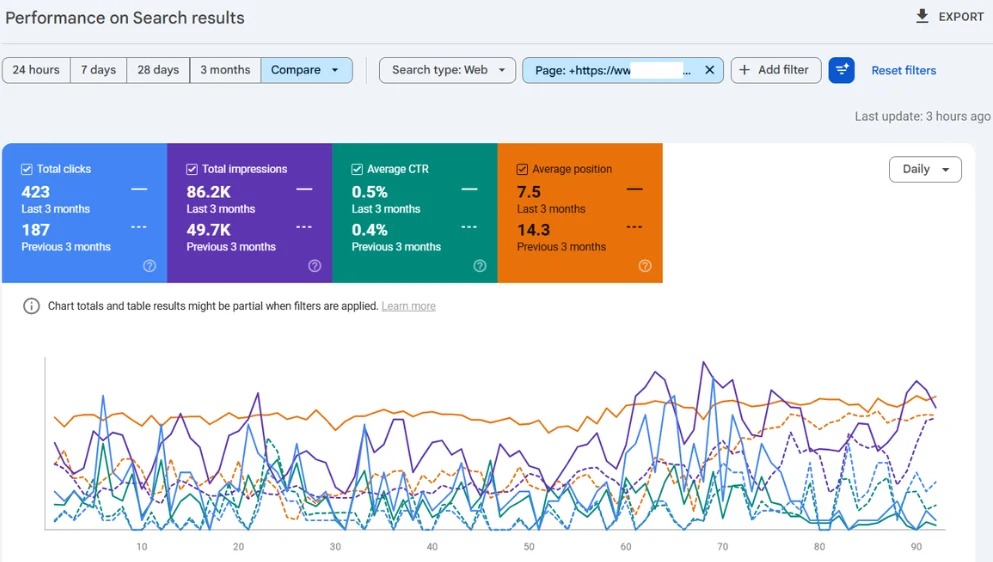
Google Search Console page-filtered comparison, last three months versus previous three months. Client details hidden for privacy.
CASE STUDY 04 · INDEXING RECOVERY
Approximately 520 fewer non-indexed URLs
A site had many non-indexed pages in Google Search Console. The documented review examined crawl paths, duplicate and thin pages, sitemap signals, internal linking gaps, and low-value URL patterns.
Observed GSC Page Indexing counts: non-indexed URLs approximately 1,650 → 1,130; indexed URLs 343 → 514.
Requesting indexing alone would not address the weak URL patterns and signals examined in the review. The comparison does not establish precise dates or attribute every indexed URL to one action.
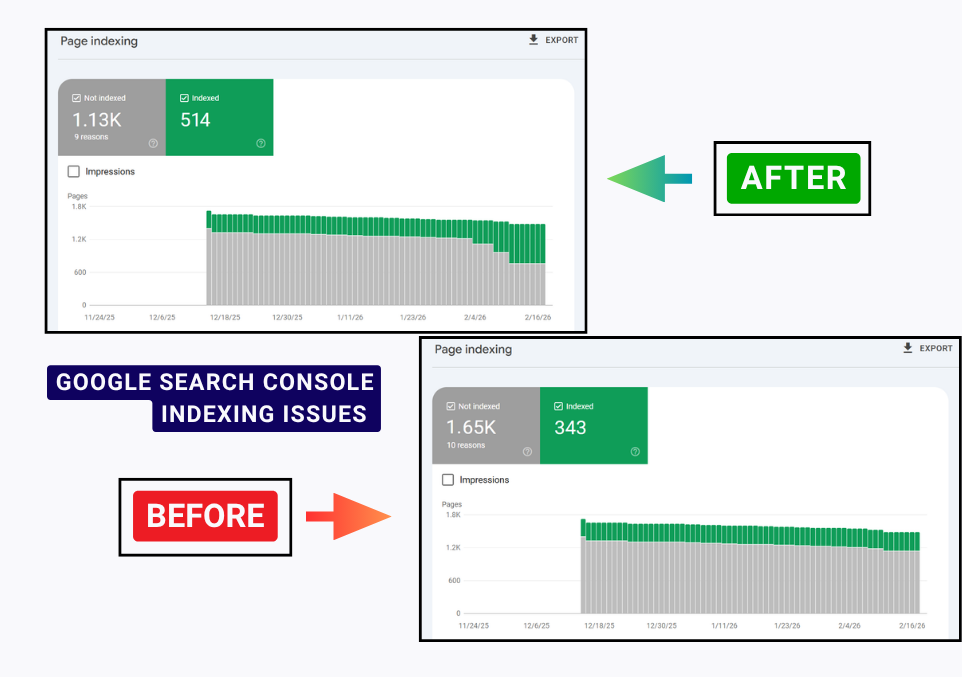
Google Search Console Page Indexing comparison. Exact comparison dates are not established by this image; client details hidden.
ON-PAGE MINI CASE · CANONICAL SIGNAL RECOVERY
190 fewer non-indexed URLs
Another ecommerce site had an indexing issue even though obvious canonical, sitemap, and robots checks did not reveal a clear break. The investigation reviewed canonical signals, crawl paths, sitemap signals, URL patterns, and Google’s selected signals.
Observed GSC Page Indexing counts: non-indexed URLs 572 → 382; indexed URLs approximately 1.13K → 1.34K.
The patterns became clearer after examining Search Console and Google’s selected signals. The comparison does not establish exact dates or prove a single confirmed cause. This mini case has no separate case-study page.
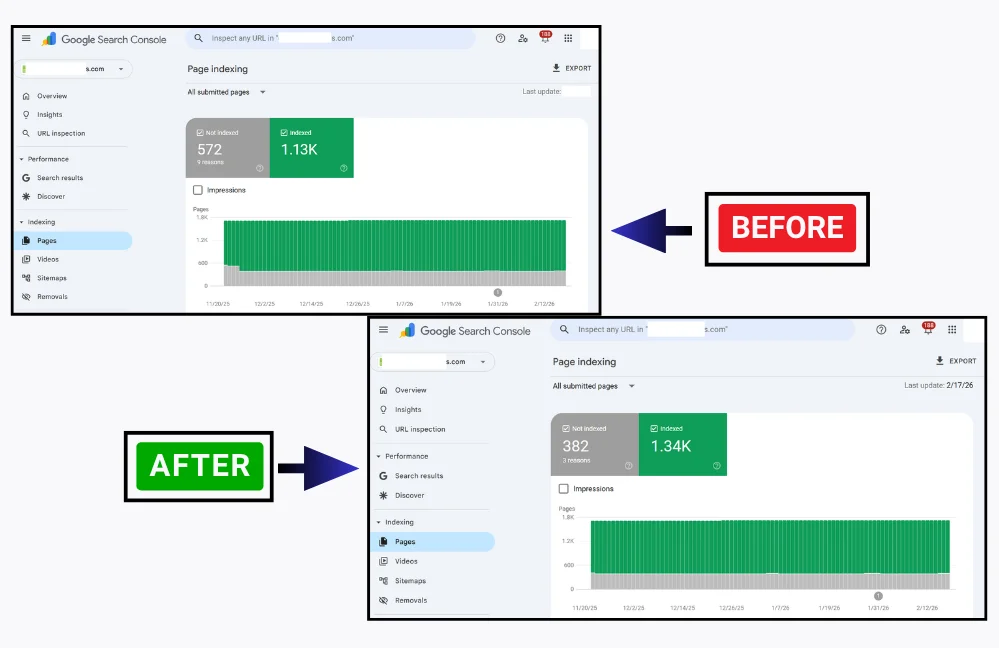
Google Search Console Page Indexing comparison. Exact comparison dates are not established by this image; client details hidden.
READING THE EVIDENCE
Understanding the Evidence
Google Search Console reports recorded clicks, impressions, and Page Indexing counts. The WooCommerce 4.3x figure is a separate Semrush estimate of monthly organic visits; it is not a GSC click count.
The Ecommerce screenshot is filtered to one page. Shopify and Ecommerce have documented comparison periods; the displayed indexing comparisons do not establish exact dates. These observed changes do not by themselves prove which work caused them or predict results for another store.
THE CONSULTING APPROACH
What These Case Studies Have in Common
The projects had different problems, but the process was similar. I do not start with a generic checklist. I start with real data, identify the pages that matter, and prioritize what should be fixed and verified.
I ask:
- Which pages matter most?
- What is stopping Google from understanding them?
- Are the issues technical, structural, content-related, or tracking-related?
- Which fixes are most likely to improve visibility?
- What can safely wait?
A useful audit should show what is broken, why it matters, what to fix first, and what can safely wait. The work is checked against observed outcomes rather than ending with a long list of warnings.
NEXT STEP
Want a Technical SEO Review of Your Store?
Send your Shopify or WooCommerce store URL.
I will review it before we speak. If I see a fixable technical SEO issue, I will tell you what I found and what fixing it may involve.
If I do not see a real technical SEO problem, I will tell you that too.