
ECOMMERCE SEO CASE STUDY
Ecommerce Technical SEO Case Study: +126% Organic Clicks
A page-filtered Google Search Console comparison shows organic clicks increasing from 187 in the previous three months to 423 in the last three months. Average position changed from 14.3 to 7.5.
The ecommerce website already had organic visibility, but important pages showed room for clearer internal links, page-level signals, and technical structure. The work described here focused on those opportunities.
ORIGINAL GOOGLE SEARCH CONSOLE EVIDENCE
One page, two compared periods
+126%
187 → 423 clicks
Average position: 14.3 → 7.5
Previous three months versus last three months. These are page-filtered measurements; the screenshot does not measure storewide traffic or establish which changes caused the result.
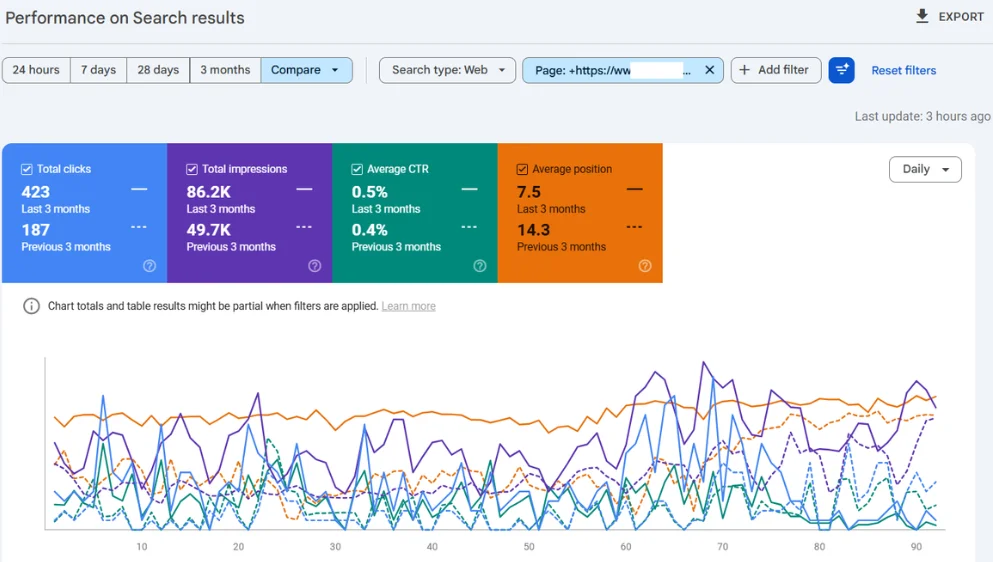
Google Search Console page-filtered comparison. Client details hidden for privacy.
01 / THE STARTING POINT
An ecommerce site with existing visibility
The website already had indexed pages and some search traffic. The original case narrative identifies important pages with impressions but weak clicks, lower average positions, and opportunities for clearer internal support, content, and page-level SEO signals.
The initial question was which pages and signals deserved attention. The source does not identify the filtered page’s URL or page type, so this case study does not assign it to a product, category, collection, or blog page.
The client is not named publicly. Google Search Console and other SEO tools informed the review; the screenshot above measures one filtered page, not the entire ecommerce site.
02 / TECHNICAL INVESTIGATION
What the review examined
The existing narrative documents a technical SEO review aimed at prioritising useful page-level opportunities instead of treating every tool warning as equally important.
Search Console and search intent
The review considered pages with impressions but low clicks, weak click-through rates, and average positions near stronger search visibility. It also considered priority URLs, changes over time, and which pages might be worth improving first.
- Google Search Console performance and page-level changes
- Pages with growing impressions or weak clicks
- Queries and URLs near stronger positions
- Content clarity and search-intent match
Titles, headings and page signals
The page-level review covered titles, headings, meta descriptions, content quality, related-page connections, structure, and technical consistency. These were areas examined; the source does not identify each as a confirmed defect on the filtered page.
- Page titles, headings and meta descriptions
- Content clarity and page structure
- Internal links and related-page connections
- Technical SEO and quality signals
Internal links and architecture
The review considered paths from homepage sections, category or collection pages, product pages, supporting content, related pages, and navigation or footer areas where useful. It also checked how main categories, products, landing pages, and supporting pages connected.
- Support for important pages through relevant internal links
- Crawl paths and ecommerce site architecture
- Connections between broader and more specific pages
Indexing and crawlability
The source describes checks of indexable and non-indexed pages where relevant, crawl paths, sitemap signals, internal links, canonical signals where needed, and page-level quality signals.
These checks help identify priorities. The source does not provide a URL-by-URL defect log, so the review areas should not be presented as individually verified fixes.
03 / DOCUMENTED WORK
How the work was prioritised
The original case narrative reports improvement work around internal links, page-level signals, structure, search-intent alignment, technical consistency, and stronger support for important ecommerce pages. It describes Google Search Console-based prioritisation and a focus on higher-impact tasks.
- Stronger internal links to important pages
- Clearer page-level SEO signals and page structure
- Better alignment with search intent and content clarity
- Technical SEO cleanup and crawl-path support
- Google Search Console-based prioritisation and later performance review
The screenshot records a change in one page’s search performance. It does not independently verify each implementation step, identify who made it, or establish which action contributed to the observed change.
04 / OBSERVED RESULT
What changed in Google Search Console
With a Page filter selected, the original screenshot compares the previous three months with the last three months. Organic clicks rose from 187 to 423, approximately +126%. Average position changed from 14.3 to 7.5.
These are measurements for the filtered page. They do not represent storewide traffic, conversions, or revenue. The comparison alone cannot attribute the change to a particular technical SEO action, and it does not guarantee a similar outcome for another site.
05 / PRACTICAL LESSONS
What ecommerce teams can take from this case
1. Start with existing data
Google Search Console can show where opportunity already exists. Pages with impressions, weak CTR, or average positions near page one can be starting points.
2. Internal links can support growth
Internal links help communicate page relationships and importance across category, product, landing, and supporting pages.
3. Page-level signals matter
Titles, headings, content clarity, and internal links should make a page’s purpose and search intent easier to understand.
4. Not every fix has the same value
A useful review focuses on issues affecting important pages instead of treating every tool warning as urgent.
5. Technical SEO needs follow-through
A report is useful, but priorities need implementation and later review to assess what changed.
Ecommerce SEO is not limited to adding products, publishing content, or building backlinks. Technical and structural review can be relevant when important pages are underperforming. It is not a universal explanation for traffic changes.
07 / DISCUSS YOUR STORE
Get an Ecommerce Technical SEO Review
If your ecommerce store has weak organic growth, indexing issues, unclear page-level signals, or technical SEO problems, I can review the visible signals first.
Send your store URL and a short note about the issue.
If there is a clear technical SEO problem, I will explain the next step.
If the issue does not look technical, I will tell you that too.