
INDEXING RECOVERY CASE STUDY
Indexing Recovery Case Study: About 520 Fewer Non-Indexed URLs
A technical review of the indexing patterns behind an ecommerce site’s non-indexed URLs. The visible Google Search Console comparison shows fewer non-indexed URLs and more indexed URLs across two snapshots.
The work separated important pages needing attention from URLs that could reasonably remain excluded. It examined crawl paths, internal links, canonicals, sitemaps and page-level signals.
ORIGINAL GOOGLE SEARCH CONSOLE EVIDENCE
What the Page Indexing screenshots show
The original comparison shows approximately 1,650 non-indexed URLs and 343 indexed URLs before, versus approximately 1,130 non-indexed URLs and 514 indexed URLs after.
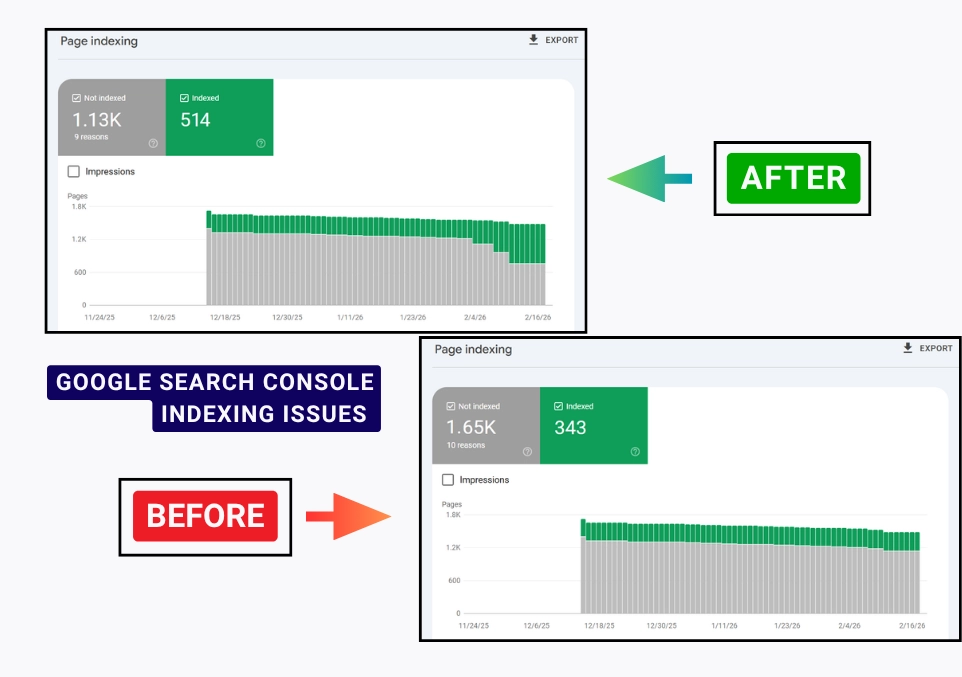
Google Search Console Page Indexing comparison. The displayed counts are rounded; client details are hidden for privacy.
View full-size Google Search Console Page Indexing evidence
That is approximately 520 fewer non-indexed URLs and 171 more indexed URLs. These are separate observed changes; the screenshots do not show that 520 URLs moved from excluded to indexed.
THE STARTING POINT
The starting point
The ecommerce site had many URLs that Google was not indexing. That count alone did not show which exclusions were problems. Some URLs can properly remain out of the index; others may be important pages with weak signals.
The first decision was to separate indexable pages worth improving from duplicate, low-value or intentionally excluded URLs. A request to index an individual URL cannot answer why a wider page type is absent from search.
TECHNICAL INVESTIGATION
The indexing patterns reviewed
The technical SEO review used Google Search Console Page Indexing data to group affected URLs by pattern and compare those groups with crawl paths, site structure and page-level signals. The categories below describe what was reviewed; the source does not establish that every possible issue was found or fixed.
Google Search Console and URL patterns
The review considered non-indexed pages, affected URL groups, sitemap-submitted URLs, canonical-related exclusions, duplicate pages, and pages Google found but did not retain in the index. It also distinguished URLs that should remain excluded from important URLs that might warrant improvement.
Crawled — currently not indexed
This status means Google crawled a URL but did not index it at that time. Possible explanations include thin or similar content, weak internal links, unclear canonical signals, low-value patterns or duplicated template output. In this project, these pages were reviewed by pattern to decide whether they warranted improvement, consolidation or exclusion.
Discovered — currently not indexed
This status means Google knows a URL exists but has not crawled it yet. The review considered whether important URLs had adequate crawl support through site structure, internal links and sitemap signals. A large URL inventory or low-priority page types can also be relevant; the available source does not identify one cause for every URL.
Canonicals, duplicates and page quality
Google may choose one of several similar URLs as canonical. That can be appropriate, or it can leave an important page out of the index. The review checked canonical consistency, duplicate or weak page patterns, indexability and the quality signals around pages that mattered.
Sitemaps and crawl paths
The review checked whether the XML sitemap pointed toward clean, important, indexable URLs and whether page status and sitemap signals aligned. It also examined crawl paths rather than assuming sitemap inclusion alone would secure indexing.
Internal links
Important pages need discoverable paths through the site. The review considered navigation, category or collection links, product links, related pages, supporting content, and contextual or footer links where relevant. These checks helped identify where important pages might need stronger crawl support.
DOCUMENTED WORK
How the work was prioritized
The documented account describes a technical SEO review followed by attention to higher-priority indexing issues. Google Search Console patterns were grouped, important URLs were distinguished from normal exclusions, and technical signals around valuable pages were considered.
- Review Page Indexing patterns, affected URL types and sitemap-submitted pages.
- Assess crawlability, crawl paths, internal linking and page-level SEO signals.
- Check canonical consistency, duplicate or low-value patterns, and indexability.
- Prioritize important pages for improvement while allowing appropriate exclusions.
- Use subsequent Search Console comparisons to assess the observed counts.
The documented work includes improving indexing signals, crawl paths and internal links, and reviewing canonical, sitemap, duplicate and weak URL patterns. It does not document individual URL edits or prove that every checked area received an implementation change.
OBSERVED OUTCOME
Fewer non-indexed URLs, more indexed URLs
Across the two Google Search Console screenshots, the non-indexed count moves from about 1,650 to 1,130—approximately 520 fewer non-indexed URLs. The indexed count moves from 343 to 514—171 more indexed URLs.
These are separate aggregate counts. The screenshots do not show URL-level status history, a fixed URL population or exact comparable dates. They cannot establish that all 520 fewer non-indexed URLs became indexed, or isolate which technical action caused the changes.
The practical value of the review was a clearer distinction between exclusions that might be expected and important pages that warranted closer attention. Google still decides which eligible pages to index.
PRACTICAL LESSONS
What this case study teaches about indexing
1. Not every non-indexed page is a problem
Some filtered, duplicate or low-value URLs can reasonably stay excluded. Diagnose which pages matter before trying to increase the indexed count.
2. Search Console patterns matter more than one URL
Review recurring patterns across templates, page types and URL groups. One URL rarely explains the larger indexing picture.
3. Internal links shape crawl paths
Important pages need clear routes from navigation, category or collection pages, products and relevant content. Weak links can make useful pages harder to discover or prioritize.
4. Canonical choices deserve review
Similar URLs can lead Google to choose a different canonical. Check that signals consistently identify the intended primary page; do not assume every duplicate should be indexed.
5. Sitemap quality supports clarity
A sitemap should emphasize clean, important, indexable URLs. Weak or outdated submissions can send mixed signals; inclusion in a sitemap does not guarantee indexing.
Requesting indexing can help with individual URLs, but persistent patterns call for a wider review of crawlability, internal links, canonicals, sitemaps, page quality and template output.
Frequently Asked Questions
TALK THROUGH THE INDEXING ISSUE
Get an Indexing Recovery Review
If important pages are missing from Google’s index, I can review the visible signals first. Send your store URL and a short note about what you are seeing.
If there is a clear technical SEO problem, I will explain a useful next step. If it does not look technical, I will tell you that too.